Saturday, 15 March 2014

History: Rome Thermae (Cultural Significance)

The baths often included, aside from the three main rooms listed above, a palaestra, or outdoor gymnasium where men would engage in various ball games and exercises. There, among other things, weights were lifted and the discus thrown. Men would oil themselves (as soap was still a luxury good and thus not widely available) and shower. Often wealthy bathers would bring a slave that carried his master's towels, oils, and strigils to the baths and then watched over them once in the baths, as thieves and pickpockets were known to frequent the baths.

In many ways, baths were the ancient Roman equivalent of community centres. Because the bathing process took so long, conversation was necessary. Many Romans would use the baths as a place to invite their friends to dinner parties, and many politicians would go to the baths to convince fellow Romans to join their causes. The thermae had many attributes in addition to the baths. There were libraries, rooms for poetry readings, and places to buy and eat food. The modern equivalent would be a combination of a library, art gallery, mall, restaurant, gym, and spa.

The Romans believed that good health came from bathing, eating, massages, and exercise. The baths, therefore, had all of these things in abundance. Since some citizens would be bathing multiple times a week, Roman society was surprisingly clean.

Emperors often built baths to gain favor for themselves and to create a lasting monument of their generosity. If a rich Roman wished to gain the favor of the people, he might arrange for a free admission day in his name. For example, a senator hoping to become a Tribune might pay all admission fees at a particular bath on his birthday to become well known to the people of the area.

History: Rome Thermae (Structure)

Plan of the Old Baths at Pompeii

A public bath was built around three principal rooms: the caldarium (hot bath), the tepidarium (warm bath) and the frigidarium (cold bath). Some thermae also featured steam bath, a moist steam bath, a dry steam bath much like a modern sauna.

By way of illustration, this article will describe the layout of Pompeii's Old Baths adjoining the forum, which are among some of the best-preserved Roman baths.

The whole building comprises a double set of baths, one for men and the other for women. It has six different entrances from the street, one of which gives admission to the smaller women's set only. Five other entrances lead to the men's department, of which two, communicate directly with the furnaces, and the other three with the bathing apartments.

Atrium

Passing through the principal entrance, which is removed from the street by a narrow footway surrounding the building and after descending three steps, the bather finds a small chamber which contained a water closet (latrina), and proceeds into a covered portico, which ran round three sides of an open court. These together formed the vestibule of the bath, in which the servants waited.
Use of the atrium

This atrium was the exercise ground for the young men, or perhaps served as a promenade for visitors to the baths. Within this court the keeper of the baths (balneator), who exacted the quadrans paid by each visitor, was also stationed. One room, which runs back from the portico, might have been appropriated to him; but most probably it was an oecus or exedra, for the convenience of the better classes while awaiting the return of their acquaintances from the interior. In this court, advertisements for the theatre, or other announcements of general interest, were posted up. At the sides of the entrance were seats (scholae).

Apodyterium 

A passage (s) leads into the apodyterium, a room for undressing in which all visitors must have met before entering the baths proper. Here, the bathers removed their clothing, which was taken in charge by slaves known as capsarii, notorious in ancient times for their dishonesty. The apodyterium was a spacious chamber, with stone seats along two sides of the wall. Holes are still visible on the walls, and probably mark the places where the pegs for the bathers' clothes were set. The chamber was lighted by a glass window, and had six doors. One of these led to the tepidarium and another to the frigidarium, with its cold plunge-bath.

Tepidarium

From the frigidarium the bather who wished to go through the warm bath and sweating process entered the tepidarium. It did not contain water either at Pompeii or at the baths of Hippias, but was merely heated with warm air of an agreeable temperature, in order to prepare the body for the great heat of the vapor and warm baths, and, upon returning, to prevent a too-sudden transition to the open air. In the baths at Pompeii this chamber also served as an apodyterium for those who took the warm bath. The walls feature a number of separate compartments or recesses for receiving the garments when taken off. The compartments are divided from each other by figures of the kind called Atlantes or Telamones, which project from the walls and support a rich cornice above them.
Three bronze benches were also found in the room, which was heated as well by its contiguity to the hypocaust of the adjoining chamber, as by a brazier of bronze (foculus), in which the charcoal ashes were still remaining when the excavation was made.

The tepidarium is generally the most highly ornamented room in baths. It was merely a room to sit in and be anointed in. In the Old Baths at Pompeii the floor is mosaic, the arched ceiling adorned with stucco and painting on a coloured ground, the walls red.
Anointing was performed by slaves called unctores and aliptae. It sometimes took place before going to the hot bath, and sometimes after the cold bath, before putting on the clothes, in order to check the perspiration. Some baths had a special room (destrictarium or unctorium) for this purpose.

Caldarium

From the tepidarium a door opened into the caldarium , whose mosaic floor was directly above the furnace or hypocaust. Its walls also were hollow, forming a great flue filled with heated air. At one end was a round basin (labrum), and at the other a quadrangular bathingplace (puelos, alveus, solium, calida piscina), approached from the platform (schola) by steps. The labrum held cold water, for pouring upon the bather's head before he left the room. These basins are of marble in the Old Baths, but also made of alvei of solid silver. Because of the great heat of the room, the caldarium was but slightly ornamented.

Service

The apodyterium has a passage communicating with the mouth of the furnace, called praefurnium or propigneum; and, passing down that passage, we reach the chamber, into which the praefurnium projects, and which is entered from the street at. It was assigned to the fornacatores, or persons in charge of the fires. Of its two staircases, one leads to the roof of the baths, and one to the boilers containing the water.

There were three boilers, one of which (caldarium vas) held the hot water; a second, the tepid (tepidarium); and the third, the cold (frigidarium). The warm water was turned into the warm bath by a pipe through the wall, marked on the plan. Underneath the hot chamber was set the circular furnace, of more than 7 ft. in diameter, which heated the water and poured hot air into the hollow cells of the hypocaustum. It passed from the furnace under the first and last of the caldrons by two flues, which are marked on the plan. The boiler containing hot water was placed immediately over the furnace; and, as the water was drawn out from there, it was supplied from the next, the tepidarium, which was raised a little higher and stood a little way off from the furnace. It was already considerably heated from its contiguity to the furnace and the hypocaust below it, so that it supplied the deficiency of the former without materially diminishing its temperature; and the vacuum in this last was again filled up from the farthest removed, which contained the cold water received directly from the square reservoir seen behind them. The boilers themselves no longer remain, but the impressions which they have left in the mortar in which they were imbedded are clearly visible, and enable us to determine their respective positions and dimensions. Such coppers or boilers appear to have been called miliaria, from their similarity of shape to a milestone. Behind the boilers, another corridor leads into the court or atrium appropriated to the servants of the bath.

Women's bath

The adjoining, smaller set of baths were assigned to the women. The entrance is by the door, which conducts into a small vestibule and from there into the apodyterium, which, like the one in the men's bath, has a seat (pulvinus, gradus) on either side built up against the wall. This opens upon a cold bath, answering to the natatio of the men's set, but of much smaller dimensions. There are four steps on the inside to descend into it.

Opposite to the door of entrance into the apodyterium is another doorway which leads to the tepidarium, which also communicates with the thermal chamber, on one side of which is a warm bath in a square recess, and at the farther extremity the labrum. The floor of this chamber is suspended, and its walls perforated for flues, like the corresponding one in the men's baths. The tepidarium in the women's baths had no brazier, but it had a hanging or suspended floor.

History: Rome Thermae (Introduction)

In ancient Rome, Thermae (from Greek thermos, "hot") and balnea were facilities for bathing. Thermae usually refers to the large imperial bath complexes, while balneae were smaller-scale facilities, public or private, that existed in great numbers throughout Rome.

Most Roman cities had at least one, if not many, such buildings, which were centers not only for bathing, but socializing. Roman bath-houses were also provided for private villas, town houses, and forts. They were supplied with water from an adjacent river or stream, or more normally, by an aqueduct. The water would be heated by a log fire before being channeled into the hot bathing rooms.

History: Islamic Hamam (Purpose)

Aside from treating oneself to the pleasure of bathing and chat, people went to the hamam for religious cleansing. Before one would don new clothes, after a long journey, a convalescence, or release from prison--these were good reasons to clean up and check in with Allah.

The hamam was so much a part of town social life that even the wealthy, who usually owned private baths, frequented them. They chose public bathing to show the town they were clean. Although the baths were usually built under the auspices of church or government, they were often constructed by wealthy individuals as well.
When a new bath was opened, a herald proclaimed the news that the bath would be free to everyone for the first three days.

Massage attendants rubbed their hands with pomegranate peel to harden them and give them a pleasant scent. Attendants also made sure no beans or peas were eaten in the hamam, no lepers were allowed inside, and anyone revealing a peek at his private parts was ejected. Not only was the hammam pleasurable, but it also brought luck as this old adage claims: "Whoever goes to the bath on forty consecutive Wednesdays will succeed at anything they do."

History: Islamic Hamam (Structure)

The hamam developed into a quiet retreat--an atmosphere of half-light, quiescence and seclusion. Architecturally, vaulted ceilings shrank as the buildings became smaller and modest. While the Romans built enormous central baths, the Arabs preferred several small baths throughout their cities. They still followed a progression through a series of hot rooms as in the thermae, but with different emphasis.

In the hamam the Roman dwindled to a mere passageway leading from dressing room to hot room where, unlike the Roman caldarium, special massages were administered. While the Roman bather finished with a stay in the library or study, the hamam bather ends where he or she began, lounging on couches in the rest hall while servants bring drinks and cool the bather with fans.

The hypocaust heating systems remained, but in some regions Arabs followed the Roman example of utilizing heat from their many hot springs. These hamams, called kaplica or ilica, have no sweat platform in the center of the hottest room. Instead, a pool of natural hot water heats the hamam. Because the water bubbled and flowed, the Arabs could take a dip in those pools without bathing in their own filth.

Like the Roman baths, the hamam became a place to socialize. "Your town is only a perfect town when there is a bath in it," said Abu Sir, an early Arab historian. To promote the local hamam, entrance fees were so low everyone could enjoy them. "I leave it to the bather," said a caliph in A Thousand and One Nights, "to pay according to his rank."
 The baths were one of the few places in Islam open to everyone from early morning to late night, and sometimes longer.

Order and cleanliness were essential to the hamams, so certain customs, enforced by law, were established. The police inspector was given the task of seeing that the baths were washed frequently, which entailed scrubbing the stone surfaces with a hard instrument to remove dirt and slippery traces of soap. The inspector also checked the quality of the water. Aside from cleaning the place, the attendants burned incense twice a day for purification. The hamam was required to be fully prepared before dawn so people could bathe before Morning Prayer.

History: Islamic Hamam (Introduction)

Muhammad believed that the heat of the hamam (which in Arabic means "spreader of warmth") enhanced fertility, and the followers of the faith should multiply. Until the hammam caught Muhammed's fancy, the Arabs used only cold water and never bathed in tubs, which was considered as bathing in one's own filth. But when the conquering Arabs encountered Roman and Greek baths in Syria, holy men immediately adopted the pleasure of hot air bathing (perhaps to compensate for the joys of alcohol forbidden by their faith).

As the Arabs picked up foreign bathing habits, they were quick to tailor them to their own ways. The hamam gained religious significance and became an annex to the mosque, used to comply with the Islamic laws of hygiene and purification. Physical and intellectual development was deemphasized, and only the massage remained.

Once the delight of the warm water sunk in, the cold water bath or shower after sweating no longer appealed to the Arabs.

History: Turkish Bath (Structure)

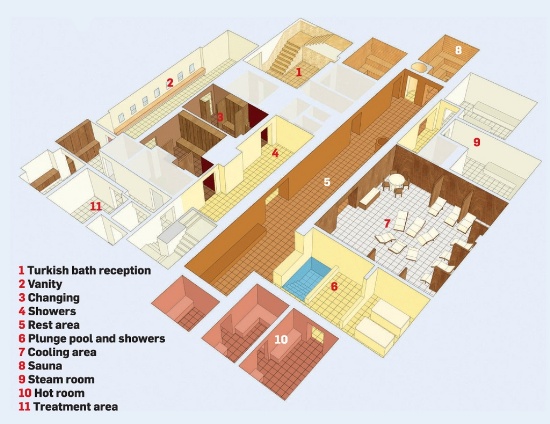
A typical hamam consists of three basic, interconnected rooms: the sıcaklık, which is the hot room; the warm room (tepidarium), which is the intermediate room; and the soğukluk, which is the cool room. The main evolutionary change between Roman baths and Turkish baths concerns the cool room.

The hot room (sıcaklık)

Purpose: soaking up steam and getting scrub massages

Features:
  • a large dome decorated with small glass windows that create a half-light 
  • contains a large marble stone called göbek taşı (tummy stone) at the center that the customers lie on, 
  • niches with fountains in the corners

Warm room (tepidarium) 

Purpose: washing up with soap and water

Cool room (soğukluk)

Purpose: relax, dress up, have a refreshing drink, sometimes tea, and, where available, a nap in a private cubicle after the massage. A few of the hammams in Istanbul also contain ritual cleansing baths for Jewish women. 


Hamam complexes usually contain separate quarters for men and women; or males and females are admitted at separate times. Because they were social centers as well as baths, hamams became numerous during the time of the Ottoman Empire and were built in almost every Ottoman city. On many occasions they became places of entertainment (e.g. dancing and food, especially in the women's quarters) and ceremonies, such as before weddings, high-holidays, celebrating newborns, beauty trips.